Discovering a breast lump can cause immediate concern, but a lump does not automatically mean cancer. Breast lumps have several possible causes, including benign conditions.
The important step is not to guess the diagnosis from texture or online descriptions. A new or changing lump should be appropriately assessed.
Patients around Pimpri Chinchwad, Maharashtra, can prepare for consultation by understanding how breast lumps are generally evaluated.
Start With Clinical Assessment
A doctor will usually ask how long the lump has been present, whether it changes during the menstrual cycle and whether there are associated symptoms.
The examination may assess the lump's location, size and characteristics along with the surrounding breast and nearby lymph node areas.
Age and medical history also influence the next step.
Imaging May Be Recommended
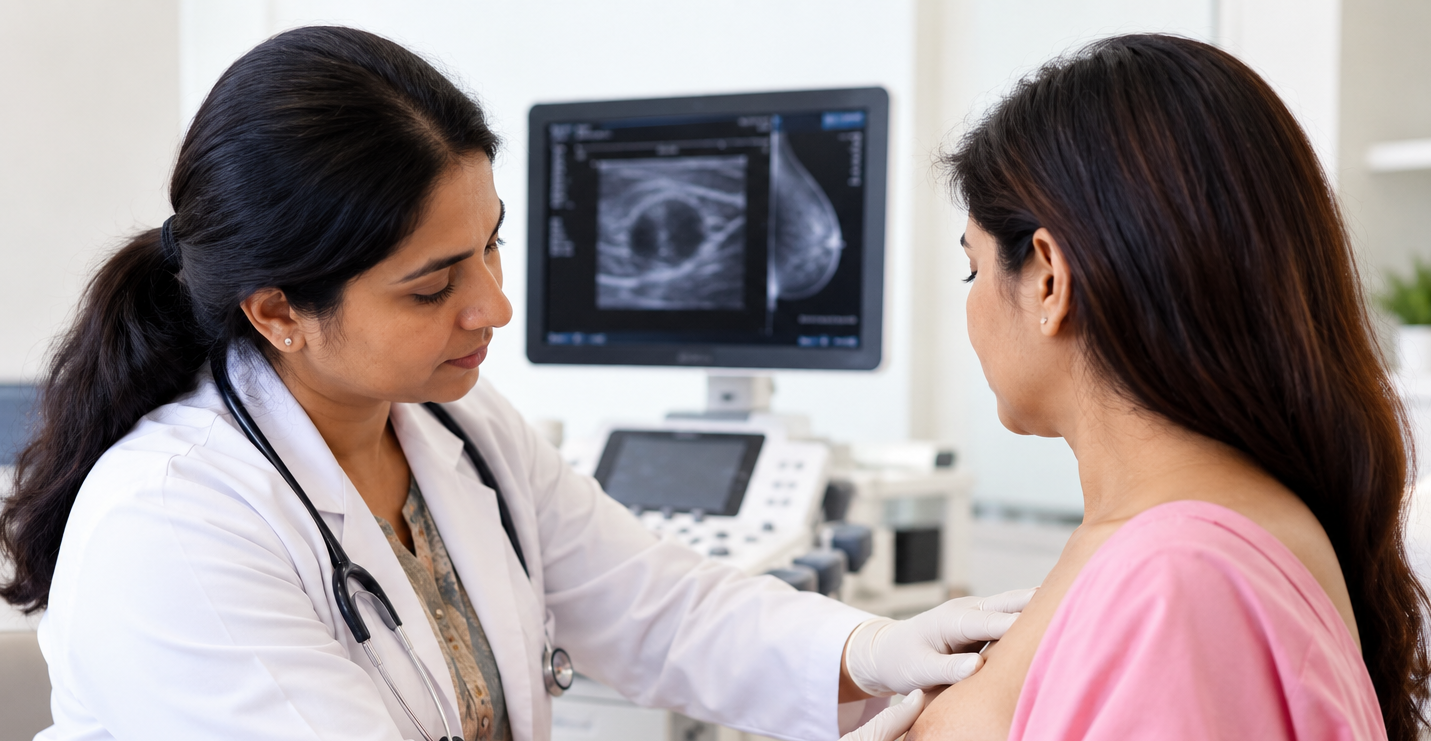
Breast imaging can help characterise a lump.
Depending on age and clinical circumstances, ultrasound, mammography or other investigations may be recommended.
Imaging does not always provide the complete answer. Some findings require tissue sampling, such as a core needle biopsy, to establish the diagnosis.
Patients should avoid assuming that a biopsy recommendation means cancer has already been diagnosed. Biopsy is a diagnostic tool used to determine what a tissue abnormality actually represents.
Changes Worth Reporting
In addition to a palpable lump, tell the doctor about:
- Nipple discharge
- New nipple inversion
- Skin dimpling
- Persistent focal breast changes
- Redness or swelling
- Changes in breast shape
- A lump in the armpit
These features do not establish a diagnosis by themselves but are relevant during assessment.
Do Not Judge a Lump by Pain Alone
A common misconception is that a painful lump is harmless while a painless lump is dangerous.
Pain alone cannot reliably make that distinction.
Some benign breast problems can be painful, and clinically important abnormalities may be painless. Any persistent new lump deserves assessment based on its overall characteristics.
Bring Previous Breast Reports
Previous mammograms, ultrasounds and biopsy reports can be valuable when a new finding needs comparison.
Patients from Wakad, Pimple Nilakh, Tathawade and nearby localities should bring these records to their appointment whenever possible.
A general surgeon can participate in breast lump assessment and determine what additional imaging, biopsy or specialist management is appropriate.
Dr. Bharat Oza provides surgical consultation for patients seeking evaluation of breast lumps and other general surgical concerns.
The purpose of assessment is to move from uncertainty to a diagnosis. Treatment should come after the nature of the lump has been adequately evaluated.
Frequently Asked Questions
Does every breast lump mean cancer
No. Many breast lumps are benign, but a new or persistent lump should be assessed rather than diagnosed by assumption.
Can young women develop breast lumps
Yes. Breast lumps can occur at different ages and have multiple possible causes.
Does a painless breast lump need assessment
Yes. The presence or absence of pain cannot reliably determine the cause of a lump.
Why might a biopsy be recommended
A biopsy obtains tissue that can be examined to establish the nature of an abnormal area when clinically indicated.
Keywords