Gallstone pain is not always a brief bout of indigestion: its location, timing, duration, and associated symptoms determine how urgently you need help. By the end, you will know which patterns fit a temporary duct blockage, which suggest inflammation or complications, and what to do while arranging medical care.
Key takeaways
- Steady upper-right abdominal pain lasting 30 minutes or longer needs medical attention.
- Fever, jaundice, repeated vomiting, or worsening pain requires urgent assessment.
- Call emergency services for severe pain with fainting, confusion, or breathing difficulty.
- Avoid fatty food and arrange care; do not self-treat repeated attacks.
Which pain patterns point to a gallbladder attack?
A gallbladder attack usually causes steady right upper abdominal pain or pain beneath the breastbone, rather than brief, cramp-like indigestion. It often begins suddenly after a heavy or fatty meal, lasts about 30 minutes to several hours, and can spread to the right shoulder or between the shoulder blades.
Back pain from gallstones may feel deep and difficult to pinpoint.
| Pattern | How it feels and when it occurs | What it may indicate |
|---|---|---|
| Biliary colic | Steady pain after eating that settles within several hours | A stone temporarily blocking the gallbladder outlet |
| Acute cholecystitis | Severe, constant right upper abdominal pain that does not settle | Ongoing blockage with gallbladder inflammation |
| Gallstone pancreatitis | Intense upper-abdominal pain spreading through to the back, often with persistent vomiting | Pancreatic inflammation requiring urgent assessment |
Arrange medical assessment for pain that lasts several hours, returns repeatedly, or is severe enough to stop normal activity. Do not keep treating recurring attacks with painkillers without finding the cause.
Fever or chills alongside right upper abdominal pain increases concern for infection or significant inflammation, although older adults and people with weakened immunity may have no fever. A symptom-free interval does not prove that a stone was harmless; ultrasound and blood tests can clarify the cause.
When does gallstone pain become more concerning?
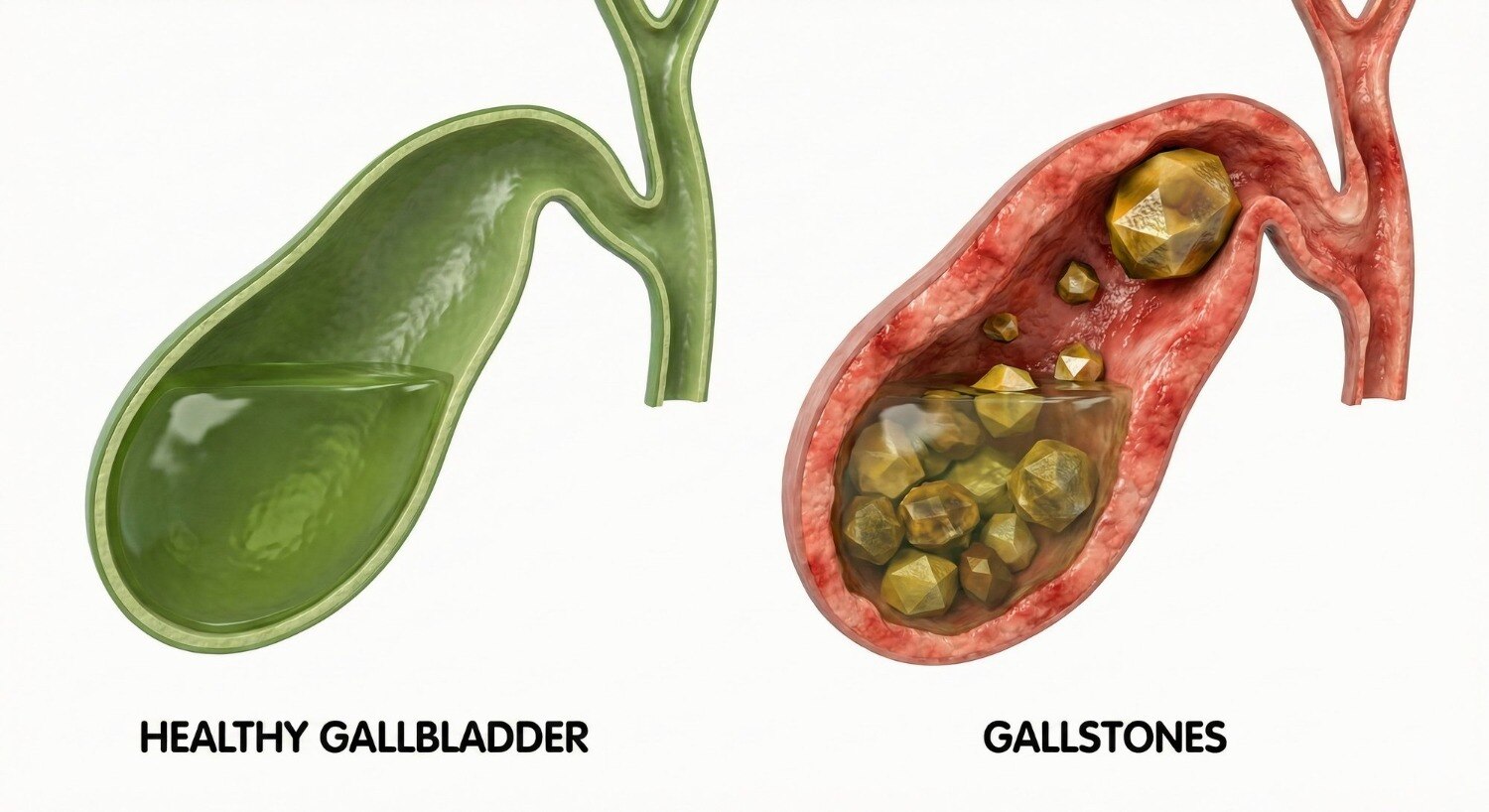
Biliary colic usually settles when a gallstone stops blocking the duct. Pain that is severe, constant, or lasting several hours is more concerning because the obstruction may have triggered acute cholecystitis, an inflamed gallbladder requiring prompt medical assessment.
| Biliary colic | Steady pain that builds after a blockage, often lasting 30 minutes to several hours, then stops when the stone moves | Arrange clinical review, especially after a first attack or recurring gallstone attacks |
|---|---|---|
| Acute cholecystitis | Persistent or worsening right-upper-abdominal pain caused by ongoing inflammation; movement or deep breathing may make it worse | Seek prompt medical assessment rather than repeatedly treating it at home with painkillers |
Pain stopping does not prove the episode was harmless. A stone can move temporarily while leaving you at risk of another blockage, inflammation, or a later complication. Repeated attacks are a reason to arrange evaluation instead of waiting for the next one.
Fever or chills with right-upper-abdominal pain makes infection or significant inflammation more likely. Fever is not required for a serious problem, particularly in an older adult or someone with reduced immunity.
Seek emergency care if the pain comes with yellow skin or eyes, confusion, fainting, marked weakness, rapid breathing, or unusually low blood pressure. These features can indicate a blocked bile duct with severe infection or sepsis, not an ordinary attack.
Which symptoms mean you need emergency hospital care?
Go to emergency hospital care now if abdominal pain comes with jaundice, fever or chills, repeated vomiting, fainting, confusion, or worsening weakness. These combinations can signal a blocked bile duct, infection, pancreatitis, severe dehydration, or sepsis rather than an uncomplicated attack.
| Warning pattern | What it may signal | What to do |
|---|---|---|
| Fever or chills with abdominal pain | Gallbladder infection or cholangitis | Seek emergency assessment immediately |
| Jaundice with pain, dark urine, or pale stools or clay-coloured stools | Common bile-duct obstruction | Go to hospital, especially if you feel unwell |
| Severe upper-abdominal pain reaching the back with persistent vomiting | Gallstone pancreatitis | Seek urgent hospital care |
| Confusion, fainting, rapid breathing, marked weakness, or very low blood pressure | Sepsis or circulatory collapse | Call emergency services |
| Repeated vomiting, inability to keep fluids down, or very little urine | Dehydration or a serious abdominal complication | Get emergency care |
A swollen, rigid abdomen or pain that becomes constant and intolerable also requires immediate assessment. Do not wait for fever: older adults and people with weakened immunity can have a serious infection without a high temperature.
Dark urine, pale stools, or generalized itching can appear before obvious yellowing of the skin or eyes. Symptoms alone cannot confirm gallstones, so hospital clinicians may use an abdominal ultrasound, liver tests, bilirubin, and pancreatic enzymes to identify obstruction or inflammation. A temporary symptom-free interval does not rule out a recently obstructing stone.
How can gallstone pain be confused with other conditions?
Gallstone pain can feel like indigestion, reflux, an ulcer, or even a heart problem because it may sit beneath the breastbone or in the upper middle abdomen. The location alone cannot identify its cause.
- Gallstones versus indigestion: Gas, bloating, burping, nausea, or loose stools alone do not prove gallstones. Indigestion often improves after passing gas or opening the bowels; gallstone pain is more likely to remain steady and severe.
- Acid reflux: Burning behind the breastbone, sour fluid in the mouth, and symptoms after lying down favour reflux. Severe upper-abdominal pain with repeated vomiting needs assessment rather than treatment as simple heartburn.
- Peptic ulcer pain: Peptic ulcer pain is usually burning or gnawing in the upper abdomen and may relate to meals. Black stools, vomiting blood, or sudden severe pain require emergency care.
- Appendicitis symptoms: Pain that begins near the navel and moves to the lower right abdomen, especially with fever or worsening tenderness, fits appendicitis more than gallstones.
- Liver disease: Dark urine, pale stools, itching, or yellow skin can indicate impaired bile flow or liver disease. Do not dismiss them as minor digestive symptoms.
- Heart attack: Chest pressure, breathlessness, sweating, or pain spreading to an arm, back, or jaw is an emergency. Do not assume it is gallstone pain.
Pain through to the back with persistent vomiting can signal gallstone pancreatitis. Only clinical assessment, often including ultrasound and blood tests, can separate these conditions.
What should you do during an attack while arranging care?
Stop solid food when pain is severe, persistent, or accompanied by nausea. Take small sips of water or an oral rehydration solution only if you can keep fluids down. Repeated vomiting or inability to drink needs urgent assessment because dehydration can develop quickly.
- Do not force food, alcohol, or fatty drinks during the episode. Resume light food only after symptoms settle and you have received medical advice.
- Take only a medicine you already know is safe for you, following its label or prescription. Do not repeatedly mask several hours of pain with painkillers, and avoid taking someone else’s antibiotics or medicines.
- Ask someone to take you for care if the pain is severe, constant, spreads to your back, or comes with weakness, fever, jaundice, fainting, or repeated vomiting. Do not drive yourself; pain, dehydration, or a sudden worsening can make driving unsafe.
- Tell the clinician when the pain began, what you ate, whether it recurred, and how often you vomited. A symptom-free interval does not prove that a stone did not obstruct a duct.
Assessment usually starts with an abdominal ultrasound. Liver tests and bilirubin can indicate bile-duct obstruction, while pancreatic enzymes such as lipase help identify pancreatitis. Dr Bharat Oza - Laparoscopic Surgeon can use these findings with your examination to separate a gallbladder attack from conditions needing urgent hospital treatment.
Frequently asked questions
Which pain patterns point to a gallbladder attack?
Gallbladder pain is usually steady pain beneath the right ribs or breastbone. It can start after a heavy or fatty meal, last 30 minutes to several hours, and spread to the right shoulder or between the shoulder blades.
When does gallstone pain become more concerning?
Seek prompt medical assessment when pain lasts several hours, keeps returning, worsens, or occurs with fever, chills, jaundice, dark urine, pale stools, or repeated vomiting.
Which symptoms mean you need emergency hospital care?
Go to emergency care for severe or worsening abdominal pain with fainting, confusion, breathing difficulty, persistent vomiting, high fever, or yellow skin and eyes.
How can gallstone pain be confused with other conditions?
Pain from indigestion, stomach ulcers, pancreatitis, liver disease, kidney stones, appendicitis, or a heart attack can feel similar. Chest pressure, sweating, breathlessness, or pain spreading to the arm or jaw needs emergency assessment.
What should you do during an attack while arranging care?
Stop eating, especially fatty foods, sip fluids if you can keep them down, avoid driving if pain is severe, and arrange medical care. Do not take medicines that are unsafe for you or delay assessment during warning symptoms.